The Future of Compute
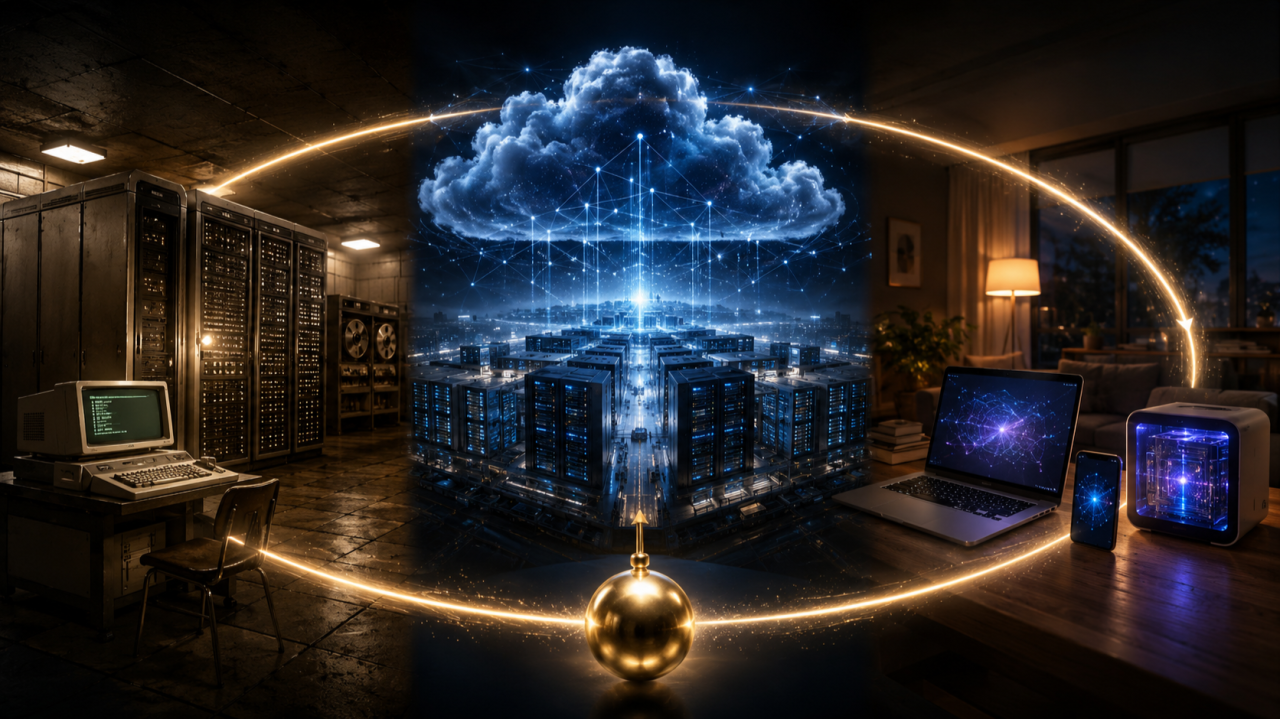
Shows a mainframe, a modern datacenter and home computing devices
The future of computing is hyper-localized.
I'm not talking about the data center located a few miles from your office. That's what CDNs and edge-caching networks have quietly managed for decades. We are on the precipice of something far more radical: high-power computing workloads running directly within your physical perimeter, meaning on your personal devices and inside your home.
It’s easy to look out at the massive datacenter buildouts currently consuming global power grids and conclude that centralized cloud computing is the permanent future. That is an expensive illusion. In reality, pure cloud-based computing is a paradigm of the past.
To build applications capable of serving billions of concurrent users over the last twenty years, we were forced to construct colossal, centralized compute clusters spanning the globe. We pointed users to web-hosted services, shifting compute-intensive workloads away from consumer devices to massive remote server farms. It was a beautiful piece of technological orchestration. It felt like magic, and it just worked.
But the tectonic plates of hardware efficiency have shifted, and the industry is looking in the wrong direction. We are repeating a well-documented historical cycle.
Forty years ago, enterprises operated on dumb terminals connected to a central mainframe, where compute-intensive workloads were processed. The local screen was merely a passive glass terminal displaying the remote output. What shattered that centralized monopoly was the advent of the personal computer. Almost overnight, the industry pivoted from mainframes to localized computing. Suddenly, you had a machine on your desk capable of processing complex workloads directly. That shift improved efficiency and gave rise to entirely new industries, creating the modern software economy we navigate today.
But cycles demand a counterweight. As applications grew denser and the web matured, the pendulum swung back. Workloads retreated to massive datacenters, and our personal devices shrank once more into high-tech dumb terminals disguised as web browsers or Software-as-a-Service (SaaS) products. We traded physical ownership of hardware for the convenience of subscription access.
Then the next enterprise transformation happened. The cloud services industry pitched a seductive promise to the corporate world: dismantle your costly, high-maintenance on-premises infrastructure and offload your operational burdens onto our servers. For financial institutions, gaming studios, and logistics giants that wanted to focus strictly on their core products, outsourcing physical server management was an obvious choice.
What followed was a corporate gold rush. Every enterprise rushed to define its "cloud strategy," migrating legacy systems wholesale in search of lower overhead. But the reality proved far harsher than the marketing. Realizing true cost efficiencies required rebuilding the software from the architectural foundation to be cloud-native, meaning optimized to scale down to zero when idle. Some adapted. Many did not. Those who failed ended up paying predatory premiums to rent the exact same capacity they once owned, while others retreated to hybrid compromises. This involved burying legacy servers in shared colocation facilities (colos) or settling for off-the-shelf SaaS solutions and deprecating highly customized, in-house-built software.
It’s been fascinating to have operated within that machinery for 17 years, watching those migrations unfold from the inside. That involved everything from working with enterprises undergoing modernization to working on the very platforms those companies migrated to. But we are blind to the next paradigm. The technology sector is so obsessed with scaling centralized server farms to meet demand for artificial intelligence that it is completely missing the seismic shift occurring at the edge.
Back in March 2026, Apple released the MacBook Pro M5 Max, a remarkably efficient workstation packing enough on-device compute and unified memory to run intensive workloads such as LLM training. Only two years ago, executing those exact workloads would have required renting expensive, highly contested compute clusters from one of the major cloud providers. Simultaneously, Nvidia is preparing to release the RTX Spark superchip, a new GPU designed to bring supercomputing-level capabilities directly to individual workstations.
Moore’s Law isn’t dead; it has simply adapted. The industry has forgotten that innovation doesn’t just happen in the hyperscale cloud. Apple recently spent an hour and a half demonstrating the new frontier model they distilled from Gemini to power Siri AI on iPhones, Macs, and iPads. That’s a massive milestone (Android did it first, but I digress), but not for the reason most analysts assume.
We are about to realize that local, consumer-grade hardware can execute complex, latency-sensitive intelligence tasks with a responsiveness that central clouds cannot replicate affordably. What once required massive server arrays will soon run silently in our pockets, behaving so seamlessly that the underlying complexity becomes entirely invisible. This is the next true evolution of our industry: hyper-localized compute, engineered for you, governed by you, running on your own physical metal.
The assumption that we must keep building massive centralized datacenters to sustain the AI era is fundamentally flawed. In fact, the most dangerous bubble in technology today isn't AI software (it's truly great, a shift more important than the internet), it is the physical datacenter infrastructure itself. Investors and businesses have invested literally trillions of dollars in datacenter buildouts to meet demand that will be fully localized on personal devices over the next couple of years.
The future is compute in your home that can handle workloads previously done in datacenters for a fraction of the cost. Critically, the capital expenditure cost will be on the consumer, not the business, because the hardware will be purchased as a lifestyle asset.
Picture the landscape of a near-future household. You walk through your front door. Your phone automatically pairs with your local network. Instead of pulling gigabytes of software updates, localized LLM weight updates, and heavy data files over congested external fiber lines, they are already waiting for you, fully pre-processed within your private compute cluster, an asset purchased as a standard utility when you bought your home.
It sits in a specialized closet, just like a battery backup or a water heater. You have a localized compute cluster that is a streamlined, modular array of memory, storage, and processing units engineered for hot-swappable ease. You do not need a degree in systems engineering to manage it.
Your private compute cluster has a warranty, just like your solar plan, and it’s managed entirely by an on-device AI agent developed specifically to maintain and optimize the system. There isn’t a service plan to buy, nor a remote technician tunneling into your private files. Your personal cluster manages your house, its maintenance, and your family's calendar.
When your system encounters hardware issues, it alerts you and automatically contacts the warranty provider to initiate repair. And when it reaches the end of life in four or five years, you can opt to upgrade to a newer set of hardware that is hot-swapped either by a technician or by yourself. The new unit provisions itself automatically and comes online without any friction.
None of this is science fiction. The underlying component technologies exist today. Orchestrated correctly, this turns your home into an active, sovereign node. You no longer just consume compute; you own it. During idle hours, you can monetize your excess capacity, leasing local processing power to businesses to run hyper-localized neighborhood workloads. It operates exactly like modern residential solar panels, selling surplus energy back to the electrical grid.
The march of hardware is relentless, and the industry has forgotten to look up from the immediate hype cycle. We are diving into yesterday's prevailing strategy as if it were the future of computing.
When the demands of computing exceed existing supply and outstrip the physical constraints of our energy grids, innovation finds computing elsewhere, such as directly in your home or on your device.
That’s a decentralized future already being built amid the hype.